Clouds on the Range
Oregon wants to hear from you
Oregon’s Data Center Advisory Committee is developing recommendations for the state, and written public comment is open through October 24 at 5 p.m.
Data Centers & Agriculture
Independent research into how data center growth intersects with agriculture, water, energy, infrastructure and rural communities.
I’m following records, infrastructure, water, power and firsthand experiences from the communities living alongside data center development.
My goal is to find the numbers, document what is happening while it happens, and create a record we can measure against later.
What happens with your submission?
Responses may be used to identify patterns, guide follow-up research, or lead to an interview request. Your name will not be published without your permission.
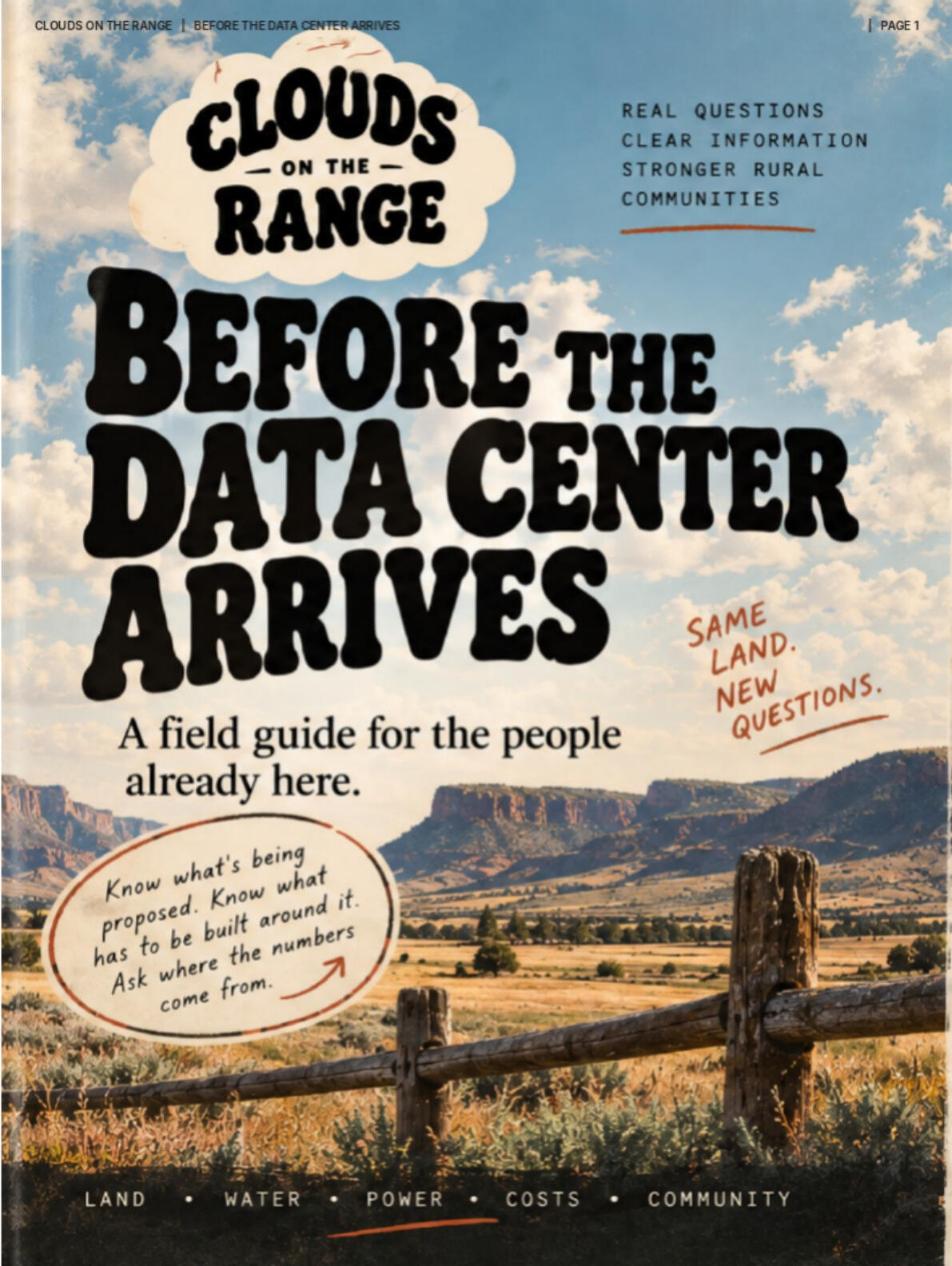
NEW FREE GUIDEBefore the Data Center ArrivesA practical guide for rural communities asking questions about data center development.
Why I started this?
Food and agriculture have been part of my life for as long as I can remember. My family has been involved in the meat industry for more than 150 years, and I’ve worked in food for most of my adult life. So when I started hearing how much water, electricity, land and infrastructure data centers can require, I had questions.
COVID was a pretty good lesson in how fragile the food system can be. Feeding people depends on farmers and ranchers, feed, fertilizer, packaging, fuel and labor. When enough pieces stop working at once, things can unravel surprisingly fast.
Water has been on my mind even longer. I grew up in the desert in the 1990s, so drought wasn’t theoretical. I also grew up in the Captain Planet era, when we were told to conserve water and warned that someday people might actually fight over it. As a kid, that sounded crazy. We turned on the faucet and water came out. There was food in the house. The electricity worked. More importantly, our parents could afford those things.
There is a big difference between knowing something is limited and actually worrying about whether you are going to be able to get it or afford it. That is part of what made me start paying attention to data centers.
I started with pretty basic questions. How much water do they use? How much power? Where is that power going to come from? What has to be built to support this? Who pays for it? And what happens when agriculture, communities, utilities and large industrial users all need more of the same resources at the same time?
Infrastructure lasts. Technology changes
We have made huge infrastructure investments before. Railroads, highways, airports, dams, water systems and the electric grid have lasted for generations. But technology moves a lot faster than a railroad. So if we are making infrastructure decisions today that could affect communities and ratepayers for 30, 40 or 50 years, I think it is fair to ask what happens if the technology looks completely different in ten.
Maybe the infrastructure we are building today ends up being incredibly valuable no matter what happens. Maybe some of it is built around assumptions that do not hold up. I do not know. But somebody is making those decisions now, and somebody is going to be paying for them. I think we should know who.
We are making a lot of decisions at once about power, water, land, infrastructure and public investment. That is what makes this feel like a butterfly effect moment to me. Small changes in a complex system can send things in very different directions later, and we may not know yet which decisions will matter most.
The future our children inherit
We are making decisions today that our children are going to live with. I do not want the next generation growing up in a world where access to food, water or electricity becomes something families have to fight over or simply cannot afford.
Access is not just about whether something exists. Food can be sitting on a shelf and still be out of reach if a family cannot afford it. Water can come out of the faucet and still be unaffordable. The same is true for electricity.
More common ground than it seems
I also think this is one of those strange issues that could bring together people who normally disagree about almost everything. A rancher may be worried about irrigation water, power rates or agricultural land. An environmental advocate may be worried about water, energy use or the watershed. They may disagree about plenty, but they may still care about the exact same land, water, power grid and communities.
The harder part is getting the answers
Which brings me back to the thing I really want to know: what are the numbers? That has turned out to be a lot harder to answer than I expected.
During one public records request, the City of The Dalles quoted me roughly $350 to produce the records I was asking for. Part of that cost was the time required to review and redact them. It is a strange position to be in, paying hundreds of dollars for access to records while part of that cost goes toward removing information before you receive them.
I understand that some information has to be protected and that public records take staff time. But when public officials are making decisions involving public resources and infrastructure, I think it is fair to ask how much of the information behind those decisions the public should be able to see.
What this project is actually trying to do
The difficulty of getting that information has become part of the research itself. I have not picked a side. I am not trying to prove that data centers are good or bad. I am trying to understand what is happening while it is happening and collect enough information that there’s something to measure against later.
If AI delivers the efficiencies being promised, we should be able to measure that. If there are costs we did not anticipate, we should be able to see those too. That is really what Clouds on the Range is about.
Who’s behind this?
Clouds on the Range is an independent research project run by Chelsea M. Schulz, based in Florence, Oregon.I fund the project myself. I do not have corporate, industry, advocacy group or institutional funding, and I am not working on behalf of a political organization or campaign.The purpose of the project is to collect information, follow the records and understand what these developments mean for agriculture, infrastructure and rural communities.
What we want to hear about
I’m looking for firsthand observations that can help document how data center development is affecting farms, ranches and agricultural communities.That might include changes involving water or wells, livestock, crops, land use, power infrastructure, utility costs, construction, roads, property impacts, or other changes you’ve noticed in your operation or community.If something doesn’t fit neatly into one of those categories, I still want to hear about it.
Case Studies
The Dalles, Oregon
Google has operated data centers in The Dalles since 2006. This case study follows water use and water rights, infrastructure, public records, development agreements and the questions that remain unanswered as the campus has expanded.
Case study in progress
Boardman / Umatilla, Oregon
This case study follows AWS data center development alongside agriculture, electricity infrastructure, industrial wastewater reuse, groundwater concerns, land use and regional growth in the Boardman and Umatilla area.
Case study in progress
Prineville, Oregon
This case study follows Meta’s data center development, water use, energy infrastructure, land use and its relationship to agriculture in the Prineville area.
Case study in progress
Read the latest research
Follow along